Often, the process of kick-starting a trucking business is as simplified as asking the question: What truck should I buy?
Checking comments, YouTube critiques, and sales materials, you will soon be able to find certain, sometimes contradictory, answers. While some praise an iconic brand, others consider the new one to be the best. A third group stands for the cheapest truck as the most reasonable choice to start out with.
These views are persuasive — and they are mostly incorrect.
These assumptions form the core of the most widespread ideal truck myths seen in early-stage trucking businesses.
A startup truck is not merely a means of transportation. It is a multilateral entity that contains capital, risk, workload, and reputation. Not only does the choice of the wrong truck hurt living conditions; it also disbalances the cash flow, limits the operating flexibility, and drains a newborn company in a quiet way before ever finding its footing.
For a truck startup, early equipment decisions often shape operational stability more than marketing or branding choices.
The text, therefore, eloquently deals with the most frequent “ideal truck” manifestation myths. It explains the reasons for their existence and shows the crucial dimensions the entrepreneur needs to take into consideration when buying a truck, especially in the beginning when they are starting up.
At this stage, buying a truck for business becomes a strategic decision rather than a simple purchasing act.
Myth 1: “One Type of Truck Is Common to All Startups”
This is the number one most widely accepted myth in startup logistics. The idea that one specific truck model is the best choice for all inexperienced operators keeps many people dreaming of streamlined complex decision-making.
In fact, this is not the case, the one best startup truck doesn’t exist — only the one that fits a certain operation best.
A truck that is characterized by very high long-haul dry van work may be unsuitable for such routes as regional flatbed. A model that has been praised a lot for fuel economy could be a less ideal choice under the conditions of carrying heavier loads or frequently stopping and going. There are even climate factors to consider: cooling systems, axle ratios, and idle demands are different in northern and southern operations.
A startup fleet cannot avoid the need for better questions such as:
- What lanes will you run?
- How predictable are your loads?
- Are you paid per mile, per load, or per day?
- How sensitive is your operation to downtime?

Until those answers are clear, chasing a universally “ideal” truck is just guesswork.
This is why thoughtful commercial truck selection always starts with operational clarity, not brand popularity.
Myth 2: “New Trucks Are The Smartest Business Investment”
New trucks are the safest choice. They often come with warranties, modern interior designs, and there is a more favorable view toward risk with them. To most first-time owners, a brand-new truck seems like it brings the legitimacy in that it is a clear sign that the business is serious about it.
For many first-time owners, this fleet vehicle choice feels symbolic, even though its financial impact is far more practical than emotional.
But the decision from an investment in trucks’ strategies signifies “new” is not completely equal to “automatically smart.”
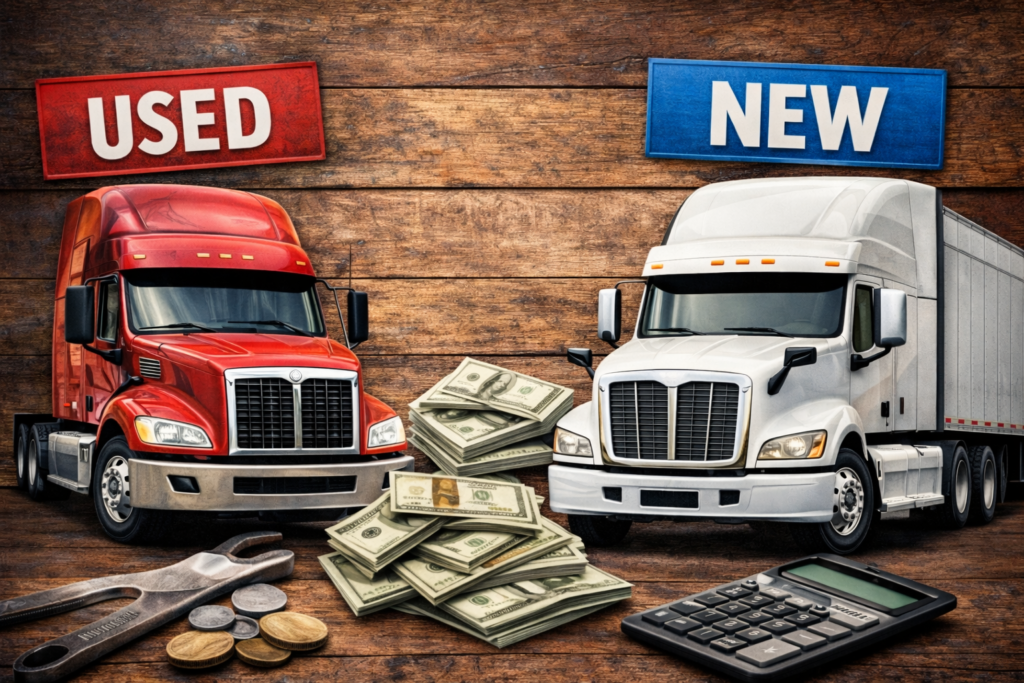
A brand new truck is one that defaces the most in depreciation during its early stage. Conversely to leasing, you will have to pay higher monthly installments, and as the asset value rises, insurance premiums will also go up. Additionally, even though warranties do diminish the ambiguity to a certain extent, they still fail to prevent repairs that will take time, for instance, when dealer service providers are overworked.
In reality, every purchase should be evaluated as part of a long-term truck investment strategy, not as a one-time upgrade.
From the standpoint of a startup that is strapped for cash, the situation may be painful. On the one hand, a hefty outlay for the purchase of one unit could create pressure in various forms: shortage of maintenance reserves, burn of fuel buffers, discrepancy in driver pay, or lack of emergency flexibility.
However, this does not mean that new trucks are wrong. One must justify them by:
- Firm freight contracts
- Predictable distance output
- Convenient financing
- A clear understanding of the cost of ownership
Without these backing “new” can turn into “fragile”.
Myth 3: “A Cheap Truck = The Least Risk”
Beliefs that the cheapest truck should be used to reduce risk counts for the other extreme angle to this phrase.
While in reality, the lowest price often comes with the most significant operational risk.
Old or consist of non-linear vehicles come out of deferred maintenance, not with a known history of the engine, with a transmission or emissions issue, or are dependent on limited parts.
For a fledgling company, shutdown is not only an inconvenience but a question of life and death. Just one unexpected failure could wipe out weeks of profit, hurt customer relations, and create disbalance in cash flow.
This moment often becomes a necessary truck reality check for operators entering the market with limited reserves.
DHAC small business trucks should be looked at from the standpoint of total cost of ownership: fuel, repairs, parts, insurance, downtime, and resale value.
Purchase Price vs. Real Cost of Ownership
| Factor | Low-Cost Used Truck | Mid-Range Used Truck | New Truck |
| Purchase price | Low | Medium | High |
| Repair frequency | High | Moderate | Low (initially) |
| Downtime risk | High | Medium | Lower |
| Financing pressure | Low | Medium | High |
| Long-term predictability | Low | Medium | High |
| Startup suitability | Risky | Often optimal | Conditional |
Myth 4: Fuel Economy Is the Most Important Metric
Fuel is one of the enormous operating expenses, so it is logical that fuel economy dominates many truck purchasing tips.
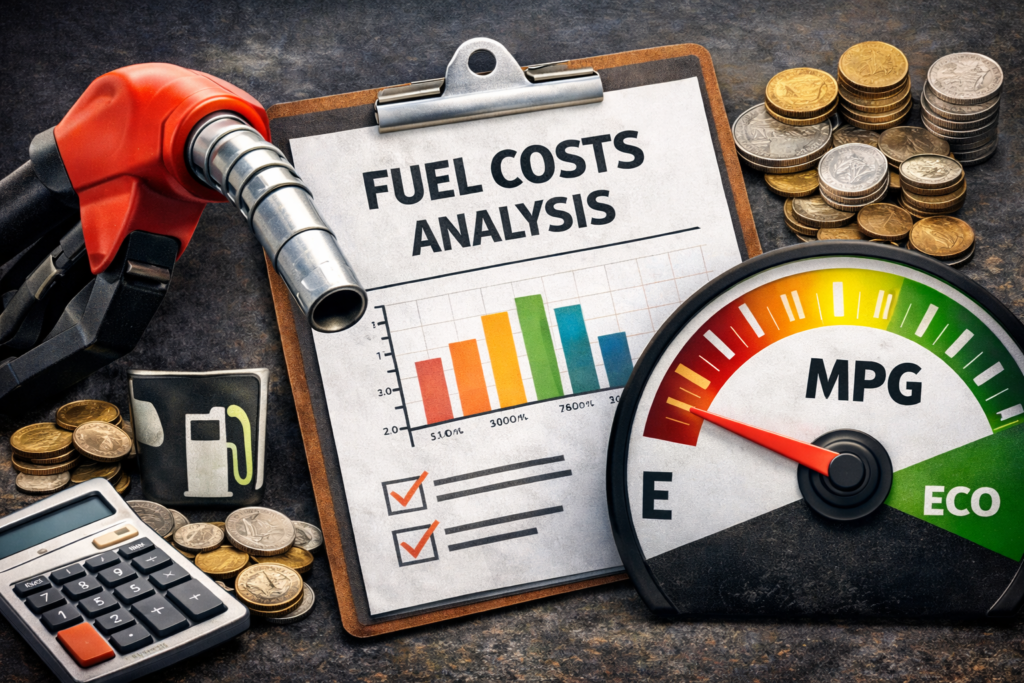
But focusing on miles per gallon alone is a partial analysis.
Fuel efficiency only matters in context. A truck with excellent MPG but frequent mechanical issues can cost more than a slightly less efficient but a more reliable commercial vehicle. Similarly, a truck optimized for highway efficiency may perform poorly in urban or regional operations.
Smart truck features analysis considers:
- Fuel economy relative to route type
- Engine reliability under expected load
- Maintenance intervals
- Driver behavior and idle time
Fuel efficiency is important — but it’s not a standalone decision factor.
Myth 5: “Bigger Engine = Better Truck”
Power sells. Engines with bigger specs are often pushed as more capable, more durable, and more “professional.”
However, in a lot of cases, i.e. the startups, there are many reasons why oversized engines are a waste of money and are more inefficient.
Unless you are frequently going up through high-altitude passes with a heavy load on board, you should also know that a large engine can:
- Reduce fuel efficiency
- Increase maintenance costs
- Reduce payload efficiency
Choosing the proper truck is all about matching the engine to the actual axles and routes, not hypothetical future scenarios. Oversizing capability is top of the list in terms of common start-up errors that eat profits quietly and over time.
Myth 6: “Financing Is Just About Monthly Payment”
To many first buyers, financing offers are reduced to a single number: the monthly payment. If it fits the budget, the deal feels manageable.
This is a dangerous simplification.
When financing a business truck, hidden conditions frequently matter more than the advertised monthly payment.
Financing a business truck affects cash flow, flexibility, and risk exposure. Some key factors that regularly get overlooked are:
- Loan term length
- Interest rate variability
- Balloon payments
- Early payoff penalties
- Maintenance obligations tied to financing
A slight increase in monthly payments with better terms is safer than a lower payment that ties the business down to strict conditions.
Financing Considerations for Startup Truck Buyers
| Financing Element | Why It Matters |
| Term length | Longer terms reduce payment but increase total cost |
| Interest structure | Fixed rates offer predictability |
| Down payment | Affects cash reserves |
| Warranty inclusion | Can offset repair risk |
| Exit flexibility | Matters if business model changes |
Myth 7: “Driver Comfort Is a Luxury for Later”
In this startup talk driver comfort is often disregarded as something left to worry about once the business can really afford it.

Such a viewpoint overlooks the reality.
In early operations, effective startup fleet management begins with preserving driver focus and consistency.
Driver fatigue extends to safety, productivity, maintenance habits, and retention it can even have an impact on single truck operations. So, a badly configured cab will reach more wear, lead to more mistakes, and cause employees to burnout quicker.
Comfort is not about luxury finishes. It is about:
- Seat ergonomics
- Visibility and mirrors
- Climate control reliability
- Cab noise and vibration
For startups, driver efficiency is business efficiency.
Myth 8: “Resale Value Doesn’t Matter at the Beginning”
Startups are so frequently occupied in survival mode that they forget to map out exit strategies ahead. Consequently, the resale value is often given so little attention that it becomes a strategic disadvantage.
This is a miscalculation.
Markets change. Routes evolve. Business models pivot. The ability to sell or trade a truck without heavy losses provides strategic flexibility.
Reliable commercial vehicles with strong resale demand offer an invisible safety net — one that becomes critical when plans change.
Factors That Protect Resale Value
| Factor | Impact on Resale |
| Brand reputation | High |
| Maintenance records | Very high |
| Mileage consistency | Medium |
| Engine popularity | High |
| Emissions configuration | Increasingly important |
What Actually Matters When Choosing a Startup Truck
When the myths are stripped away, truck decision factors become clearer and more practical.
These considerations define the real business truck requirements beyond surface-level specifications.
A smart startup truck choice balances:
- Predictability over perfection
- Reliability over prestige
- Fit over hype
The best business vehicle guide is not a spec sheet — it’s an honest assessment of how your operation will actually function day to day.
Ask yourself:
- Can this truck earn money consistently?
- Can I afford it and maintain reserves?
- Will downtime cripple my operation?
- Does it match my startup logistics reality?
If the answer to any of these is uncertain, the truck may not be wrong — but the timing might be.
Final Reality Check
There is no ideal truck in isolation. There is only an ideal match between machine, business model, and risk tolerance.
Ultimately, choosing the right truck is less about ideals and more about alignment with financial tolerance and operational demand.
For startups, success rarely comes from owning the most impressive truck. It comes from owning the most appropriate one — a truck that supports learning, adaptation, and steady growth rather than forcing the business to serve the asset.
Choosing the right truck is not about winning debates online. It’s about building a foundation that will last through the unpredictable early years of a trucking business.
And in that sense, the smartest startup truck is often the one that looks boring on paper — but performs reliably when it matters most.