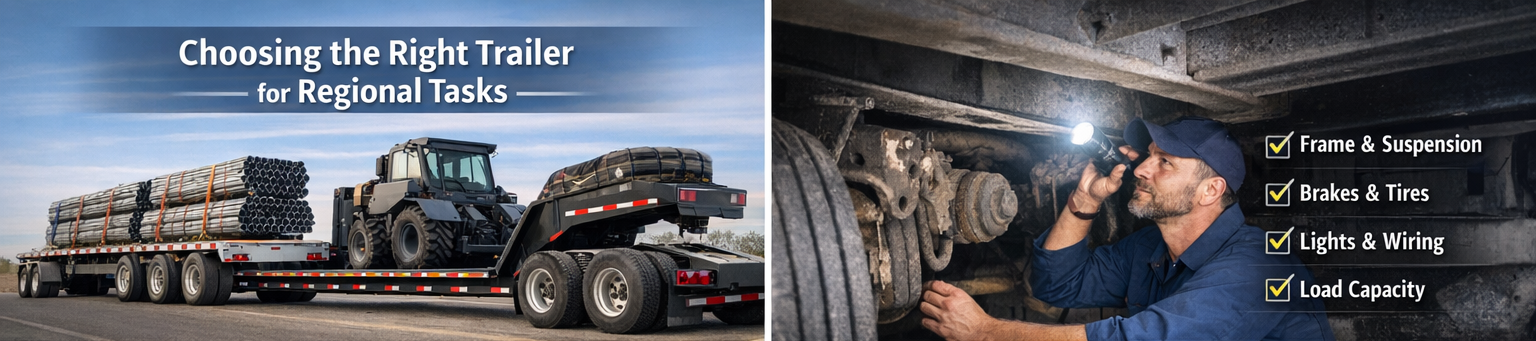
Introduction
The choice of the right trailer for regional trucking is one of the first things to look at because it impacts everything – fuel costs, driver efficiency, safety, and daily profit. Regional tasks, unlike long-haul operations, feature lots of starts, stops, multiple loading cycles, mixed road conditions, and little time for delivery. This condition makes the trailer that looks perfect on paper the one that will soon become ineffective as it goes into daily regional service.
This trailer checklist is specifically designed for truck drivers, owner-operators, and fleet managers on the regional lines. It concentrates on practical assessment – not on marketing claims – and facilitates your alignment of trailer options with real operating conditions, payload patterns, and equipment longevity.
Why Regional Tasks Require a Dedicated Trailer Checklist
Regional trucking creates a unique stress profile for equipment. In comparison to long-haul routes, trailers utilized for regional tasks usually have:
- More braking due to stay-and-go traffic, stop-and-go traffic
- Two more dock maneuvers and tight moves
- More of them partially loaded instead of their maximum capacity
- The axle stress has increased two times
- The exposure to urban curbs, potholes, and uneven surfaces has also increased
It therefore goes to say that the reason why one trailer fitting is far more crucial than another is not a matter of just maximizing size or capacity but it’s much more about regulating compatibility, durability, and performance.
Well, the right trailer helps to reduce the downtime due to proper cargo protection, and it improves the flow of the driver who has to take care of fewer repairs of the vehicle in the long run.
Correct Trailer: Match Efficiency to the Task
The first stage in any trailer buying checklist is the choice of the proper trailer type. Regional work usually entails a variety of cargo and different loading conditions, thus flexibility factor tremendously.
Common Trailer Types for Regional Tasks
Flatbed trailer
Widely used for transporting construction materials, machinery, and oversized freight. The flatbed is the fastest and easiest way of loading and unloading, giving access to multiple points and being less dependent on finding a dock — these are all great features for short runs.
Step-deck trailer
Mainly for taller loads that exceed height limits. The step-deck reduces the center of gravity which improves the stability of the trailer in the city, as well as allowing access for forklifts and cranes.
Gooseneck trailer
This is a type that you will mostly often find used for larger and heavier freight loads. The gooseneck-shaped design has a more favorable impact on the distribution of the weight and towing stability and it is outstandingly valuable when the cargo weight is different during the day.
Types of trailers used when shipping Equipment & Machinery
The right trailer type helps to cut handling time, thus improving route efficiency.
Trailer Type vs Regional Task Fit
| Trailer Type | Best Use in Regional Work | Key Advantage |
| Flatbed | Construction materials, machinery, oversized loads | Fast loading, no dock dependency |
| Step-deck | Tall freight exceeding height limits | Lower center of gravity, urban stability |
| Gooseneck | Heavy or variable-weight loads | Improved weight distribution and towing control |
Tow Vehicle Compatibility: Prevent Costly Mistakes
Tow vehicle compatibility is a serious consideration often overlooked in the trailer center. A well-built trailer turns into a liability rather than an asset if it is not properly matched with the tac.
Key factors to check:
- Fifth-wheel or hitch setup rating
- Compatibility with the electrical system
- The brake system integration
- Boundaries of the Gross Combined Weight Rating (GCWR)
Any mismatches in this area frequently trigger problems like poor handling, general driveline failure, brake imbalance, and breach of rules. In regional activities, where it is quite probable that tractors and trailers get swapped, the compatibility issue must be resolved on a consistent basis.
Weight Capacity and Payload: Think Average, Not Maximum
The importance of weight capacity and payload ratings cannot be overstated but regional trucking needs a realistic perspective. Many operators tend to pick out trailers that have max payload numbers that in most of the times they do not use.
Forget about theoretical discussion and ask practical questions:
- What is the average load per trip?
- Does the trailer frequently go out without a full load?
- Is the trailer still efficient with light or mixed loads?
Overly strong trailers add up weight without an apparent cause which increases the empty fuel consumption and accelerates the tire wear. In the regional tasks a better choice will always be a trailer that is adjusted for normal loads, instead of extreme assumptions.
Axle Rating and Suspension System: Protect both the Trailer and Cargo

Axle rating and suspension system design are the main parts that ensure durability and overall good ride quality.
Axle rating issues:
- Increased braking generates heat and elongates wear
- Partial loads can impose uneven stress
- Town driving is a power amplifier of axle fatigue
Suspension system selection:
- Air suspensions have the advantage when it comes to better cargo protection and driving comfort
- Spring suspensions are undemanding and durable in hard environments
The correct choice of the suspension system is important for regional activities as they both damage goods, and worsen the driver’s comfort, and they are also the only means to prolong component lifespan – which is vital for the everyday work.
Axle and Suspension Impact on Regional Operations
| Component | Regional Stress Factor | Operational Effect |
| Axles | Frequent braking and partial loads | Accelerated wear and heat buildup |
| Air suspension | Repeated stops and cargo shifts | Improved cargo protection |
| Spring suspension | Rough urban surfaces | Higher durability, lower complexity |
Trailer Brakes, Lights, and Electrical System
Ceaseless stop-and-go driving incessantly stresses trailer brakes. Weak brake-pull systems not only create a safety concern but also add to maintenance costs.
Key inspection areas include:
- Brake response consistency
- ABS system functionality
- Adjustment wear patterns on casters
- Check lights and electrical systems
Electrical problems featuring are common in regional operations. They are caused by vibrations, moisture, and frequent coupling cycles. Good quality wiring and sealed connectors are mandatory, not optional.
Trailer Frame and Strong Materials
The frame of the trailer is the one that will be dealing with all of the stress during regional work. Impacts on docking, curb contact, uneven pavement, and frequent cycles of loading all set the limits for structural integrity.
When checking a trailer frame:
- Analyze the quality of welds and reinforcements
- Check for corrosion resistance
- Measure cross-member spacing and strength
Investing in durable materials may come off as a heavy upfront cost, but it will significantly cut down on long-term repair bills and downtime.
Tires and Rims: Daily Wear You Cannot Ignore
Tires and rims are usually ignored as mere consumables, but the choice of them directly influences the operational efficiency.
For regional tasks:
- Tires need to be durable enough for the high levels of braking and turning
- The rims must be curb resistant
- Constant inflation is crucial to rolling resistance
Selection of poor tires will increase fuel consumption, affect stability, and shorten the service life due to uneven wear.
Loading and Accessibility: Time Efficiency Matters
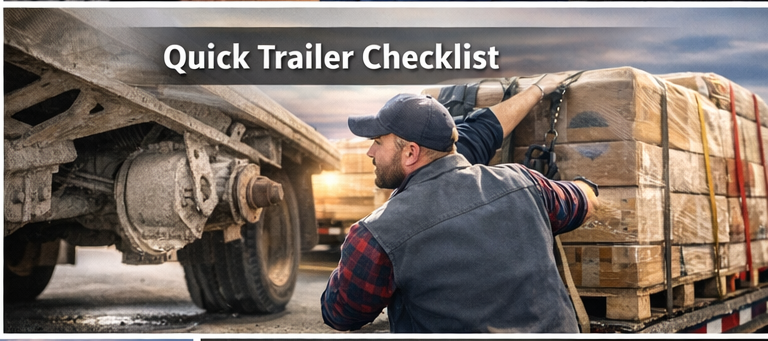
Loading and accessibility affect the duration of turnaround fully. A hard-to-load trailer not only wastes time but it also cuts down on revenue.
Consider the following:
- Side and rear access options
- Deck height relative to docks
- Compatibility with forklifts and pallet jacks
Efficient loading and accessibility enable drivers to perform more runs without extending duty hours.
Inspect Trailer Condition Before Purchase or Assignment
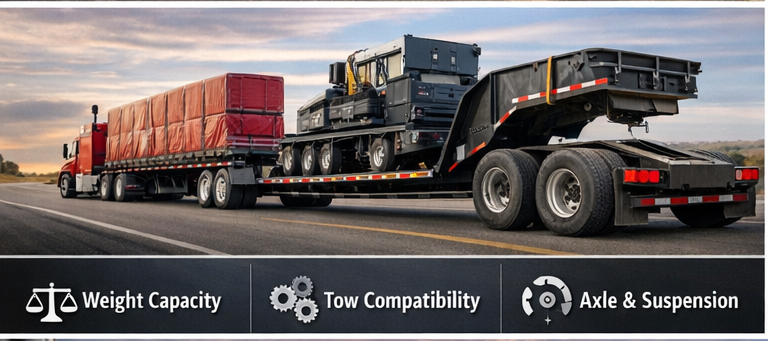
Any trailer-letting process should look at more than a simple visual scope.
Inspect:
- Frame alignment
- Suspension movement under load
- Brake wear patterns
- Electrical reliability
A trailer which appears good in a quickly done inspection but performs badly operationally will cost more in a regional service.
Quick Trailer Checklist for Regional Tasks
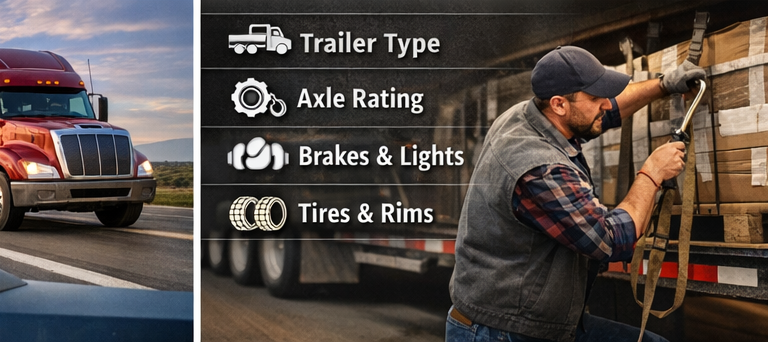
- Correct trailer type that matches the cargo
- Confirmation of the tow vehicle compatibility
- Payload averages align with average loads
- Axle rating corresponds to stop-and-go routes
- Suspension system fits the working conditions
- Trailer brakes are responsive and balanced
- Lights and electrical system function properly
- Trailer frame consists of durable materials
- Tires and rims are suitable for mixed surfaces
- Efficient loading and accessibility
Fuel Efficiency and Daily Operations
Although trailer selection leans heavily towards the build and parts of the trailer, fuel efficiency is also affected by how these parts work together in the day-to-day business. A well-matched trailer relaxes the rolling resistance, ensures better weight distribution, and cuts down on fuel use with the addition of a smoother acceleration.
When the design of the trailer, axle configuration, the suspension, and loading patterns all work in tandem, the drivers get less equipment limitations and do not have to spend all the time to compensate for these limitations.
Additional Practical Considerations for Regional Trailer Selection
When choosing right trailer for regional operations, it is important to evaluate not only specifications but also how the regional tasks trailer behaves under daily working pressure. Frequent stops, short distances, and repeated loading cycles place unique demands on equipment that are often underestimated during the selection phase.
A thorough approach to inspect trailer condition should go beyond visual appearance. Structural integrity, suspension response, and braking behavior must be evaluated in the same context as real cargo patterns and route density. This applies equally to a flatbed trailer used for construction materials, a step-deck trailer designed for taller freight, or a gooseneck trailer handling heavier and variable loads.
Special attention should also be paid to tires and rims, as they absorb a significant share of operational stress in regional work. Improper tire selection or damaged rims increase rolling resistance, accelerate wear, and quietly undermine fuel efficiency over time. Matching tire durability and rim strength to urban surfaces and repeated braking cycles is essential for maintaining consistent performance.
By treating trailer selection as an operational decision rather than a one-time purchase, fleets and owner-operators improve reliability, reduce hidden costs, and ensure that each regional task is supported by equipment suited to its real demands.
Final Thoughts
Cutting down the fuel expenses in trucking is not about sticking to fashion or relying on a few unilateral upgrades. It relies on recognizing the interplay of the trailer type, axle rating, suspension system, loading access, and tow vehicle compatibility within the day-to-day framework exclusively in regional work.
A right choice of the trailer increases effectiveness at every stage — a fewer number of delays, repairs, and, of course, compromises. Fleet and independent operators go to a higher efficiency level, protect assets, and stay profitable route after route by constantly implementing a standard trailer checklist.